Saturday, February 29, 2020

Olive-Backed Sunbird nesting

Early Jan 2020, a pair of sunbirds came to my house and started to build a nest. It took 6-7days non-stop effort from the female bird to complete the nest. It took another 4-5days for the laying and incubation of eggs.

After hatching, it took 2weeks of growing before the chick is able to fly away from the nest.  During the 2 weeks, the male and female kept feeding the chick almost non-stop during daylight. The female will sit inside the nest during night time protecting the chick.

Here are some photos of the nesting and the chick has fledged today. A youtube video of the full cycle is as attached (videos and photographs)

Full Cycle of Nesting


Monday, February 17, 2020

Sigma 100-400mm

A shot of Olive-Backed Sunbird with a prey crab spider.
Shot by the brilliant Sigma 100-400mm with D750 Nikon.


Friday, July 5, 2019

Sigma 100-400mm f5-6.3 OS HSM C

This is the most least choice of tele-zoom lens when it comes to owning and using it. The brand Sigma always turns me off as when I started photography 20yrs ago, I read a lot of negative reviews on Sigma lens. Since then, I always make sure I buy the main branded lens like Canon, Nikon,FujiFilm or Olympus. 

Since I jumped into Nikon DSLR, I used the AF-S 300mmF4D (non-OS), the overpriced AF-S 80-400mm f4-5.6 II and the great AF-S 200-500mmf5.6.

Each of the above lens has it’s pros and cons.

The 300mmf4 is super great if one is just using it for still-photography, it has a  relatively wide in aperture at great Low light Low ISO sitiuations. The sharpness of the lens t is great as it is a prime lens. The size and weight ratio are well balance for carrying and handheld. The greatest  problem is that due to no image stabiliser on lens, for doing video works, one has to bring a tripod or monopod along.  For my nature photography, most of my time is on a bicycle so bringing an extra tripod or monopod is not a preferred option. 

The 80-400mm II is overpriced for its so-so performance in my own view. The sharpness wide open is bad especially at 400mm for that price. It is good only when I stopped down to f8. Could be my copy. During video , the Stabilizer helps a lot but the focusing during video, rattling sound will be heard. I personally felt this lens is not suppose to be at that price point.

The 200-500mm is a great lens. It is sharp wide open at all focal lengths. The price is almost half the Nikon 80-400mm.The image Stabilizer is one of the  best and it can do a 4-5stops of counter shake.
The downside is the size and weight. Weighing almost 2kg, it is not fun carrying with me for Long walk or cycling. I end up using my bridge camera Panasonic FZ-1000 most of the time. This lens is seriously a good buy for anyone who wants a sharp lens, and able to handheld for shooting. Just have to plan for the day that not much walking or travelling with the lens. There are lots of good reviews on this lens.

Sigma in recent years has been producing some good lenses from the ART & Contemporary series etc and has many good reviews on them. I started to take notice of them and impression has improved.

The Sigma 100-400mmf5-6.3 is a lens that can really compare with Nikon 80-400mm. The sharpness , I feel is better than 80-400mm. Although at 400mm , the sigma lens aperture is at 6.3 vs Nikon 5.6, it is redundant as with Nikon 80-400mm, I will always shoot at f8 to get sharper images. To me a sharper image can do more thing later (cropped etc). With the new DSLR sensor where they can do ISO 3200-6400 without much ugly noise , i see the Sigma 100-400 f5-6.3 bigger aperture spec is not a disadvantage at all. 

The size and weight for this sigma 100-400 is very attractive me, it is comparable to the mirrorless Panasonic /Leica 100-400mm and Fuji 100-400mm. I think is is smaller in size then the FujiFilm 100-400mm and the sigma 100-400mm can pair with a  FF sensor vs the FUJI on a (1.5X) APS_C sensor.  This lens with DSLR can be packed into any daypack or sling bag due to it’s size. You get what i mean?However in terms of the Optical Stabilizer Mode on Sigma lens, I feel it is not as good as the 200-500mm. Nevertheless, with the 2-3 times lower price than the NIkon or Canon or FUJI counterparts, it is Super value for money. Importantly it can still gets the job done for a hobbyist like me. 

Here are some of the shots taken from Sigma 100-400mm with Nikon D750 (FF)


Friday, February 8, 2019

Nikon AF-S 200-500mmf5.6 ED VR

I had a revamped on my wildlife photo/video equipment recently. I now uses a D750 and 200-500mm lens mainly on photography and Panasonic FZ1000 for video purpose.

My old primary setup of Nikon AF-S80-400mm VR2 and D750 DSLR was used as a video cam and photography tool for my wildlife shoot (especially for wild otters). 

However, after I saw a friend of mine who uses the Panasonic FZ2500 for his video shooting on wildlife, I began to get interested in this setup. The video quality is very good. The important thing is that the FZ2500 is a bridge camera that uses a respectable 1inch sensor. I cannot really tell the difference between the D750 and FZ2500 video quality. I settled with the older generation FZ1000 which has a zoom range of 25-400mm. It also has the 1inch sensor and capable to shoot 4K video.  Handholding a DSLR and 80-400mm for videography needs some arm muscle as I need to view on the LCD of the DSLR. I need to stretch my arm forward during filming. It is more challenging to get stable filming and hard to view on the LCD when under the sun.On a bridge camera, I can view the scene thru the electronic viewfinder and locking my arms while doing the filming.  It is much comfortable and the setup of the FZ1000 is so lightweight. I enjoysthe video filming process on the Fz1000 much more.

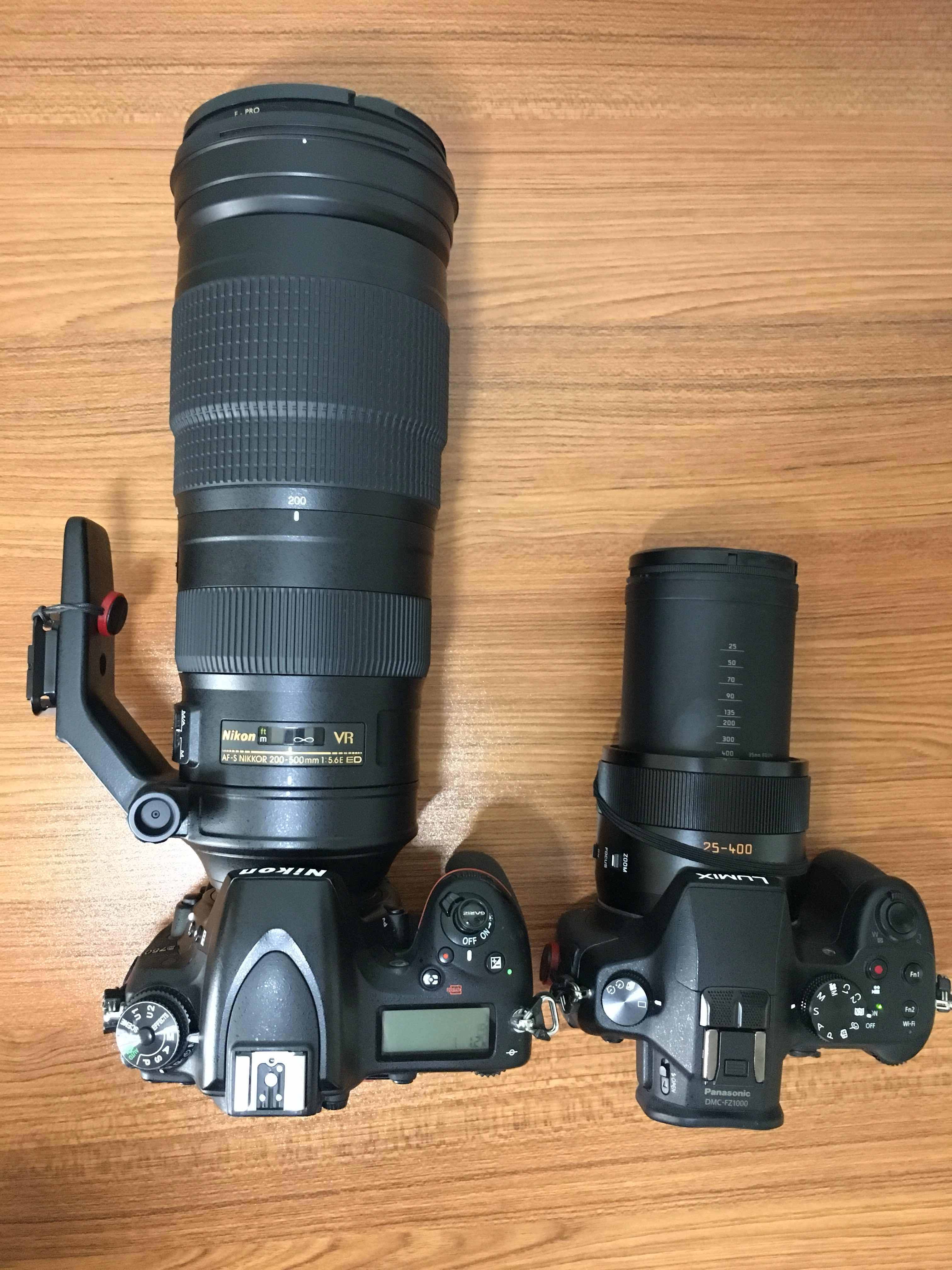
D750w200-500mm Vs FZ1000
D750 w 200-500mm vs the much smaller FZ1000 Panasonic 

The bridge camera FZ1000 Panasonic that uses a 1inch sensor. I used mainly for video filming.


Since then, the Nikon 80-400mm lens was seems to be a duplicate for video and will be used for mainly photography as a full frame DSLR photo quality is still much better than the 1 inch sensor on the bridge camera. This is especially true when used in low or bad lighting sitiuation. The full frame sensor can stretch more in terms of shadow and exposure corrections etc.

So it comes to a point that I saw the 80-400mm too expensive to hold on to. I sold this lens at SGD$1700 and bought a cheaper 200-500mmVR at $1200SGD. The review for this 200-500mm seems to be good and I decided to go ahead with the purchase. Noted that all my equipment is bought used.

The 200-500mm exceeded my expectations. It is sharp! I am impressed. I once thought that the AF-S 80-400mm with NANO coating,made-in-japan lens should a great buy compared to the  cheaper 200-500mm made-in-china lens.  I was wrong. It seems that Nikon has designed a value-for-money lens on the 200-500mm and didn’t compromised on the glass quality. The VR mode works well during handheld situation and I feel it works better than the AF-S-80-400mm. One key advantage on the 200-500mm over AF-s 80-400mm is that during video shooting the 80-400mm AF-motor will make noises during the focusing while the 200-500mm remained silent .The build quality of the 200-500mm is very similar to the much expensive 80-400mmVR2. The focusing is quick on the 200-500mm. However, the 200-500mm is also heavier than the 80-400mm. To improve the weight distribution while carrying the setup, I bought a extra Peak design plate to mount onto the lens tripod mount and attached the peak design slide strap onto it. It is comfortable as it distribute the weight evenly.

Here are some of the images from the 200-500mm on D750.


Roy 


Thursday, October 11, 2018

Nikon D750 & AF-s 80-400mmVR-ED II


With the latest market influx of fullframe Mirrorless from Nikon, Panasonic , Canon and Leica, I also went back to Fullframe. However, I still chose the DSLR Fullframe due to affordability. I recently got a D750 Nikon, upgraded from  my old 8-9 year old D7000. My last DSLR was the D600 bought in 2013.

D500 is one of my choice but I find it too expensive for a DX camera and I do not really need the pro layout body of D500 and fast FPS. 

D750 body layout is very similar to the D7000/72000/75000  but with a FX sensor. 

With D750 24MP sensor and choices of 1x, 1.2X or 1,5X crop mode, it is like a 3 in 1 camera system. I am still able to use my sharp nice 35mmf1.8DX lens at 1.2x (40mm) or at 1.5x (53mm). I tried to use the Tokina DX 11-16mm at 16mm on this FX DSLR with no vignetting. 

The next lens i plan to get for this FX DSLR is the 24-120mmf4 VR to cover a range of needs.

I also replaced my sharp 300mmf4 AF-S D lens with a more versitile AF-s 80-400mm VR2. Although i prefer the 300mm in term of photograpy output, there is no VR in the lens. The 300mm cannot be use for video without a tripod or monopod due to the extreme shake during video (Handheld). The 80-400mm VR is one of the best I have tried. I can handheld at 400mm with no shake visible during video filming.

The 80-400mm is a modern zoom lens and need to stop down to f8-f11 (at 400mm) to get a super sharp image. The above is shot at f11 and is very sharp for my eyes.


Saturday, May 12, 2018

AF-S 300mm F4 IF-D


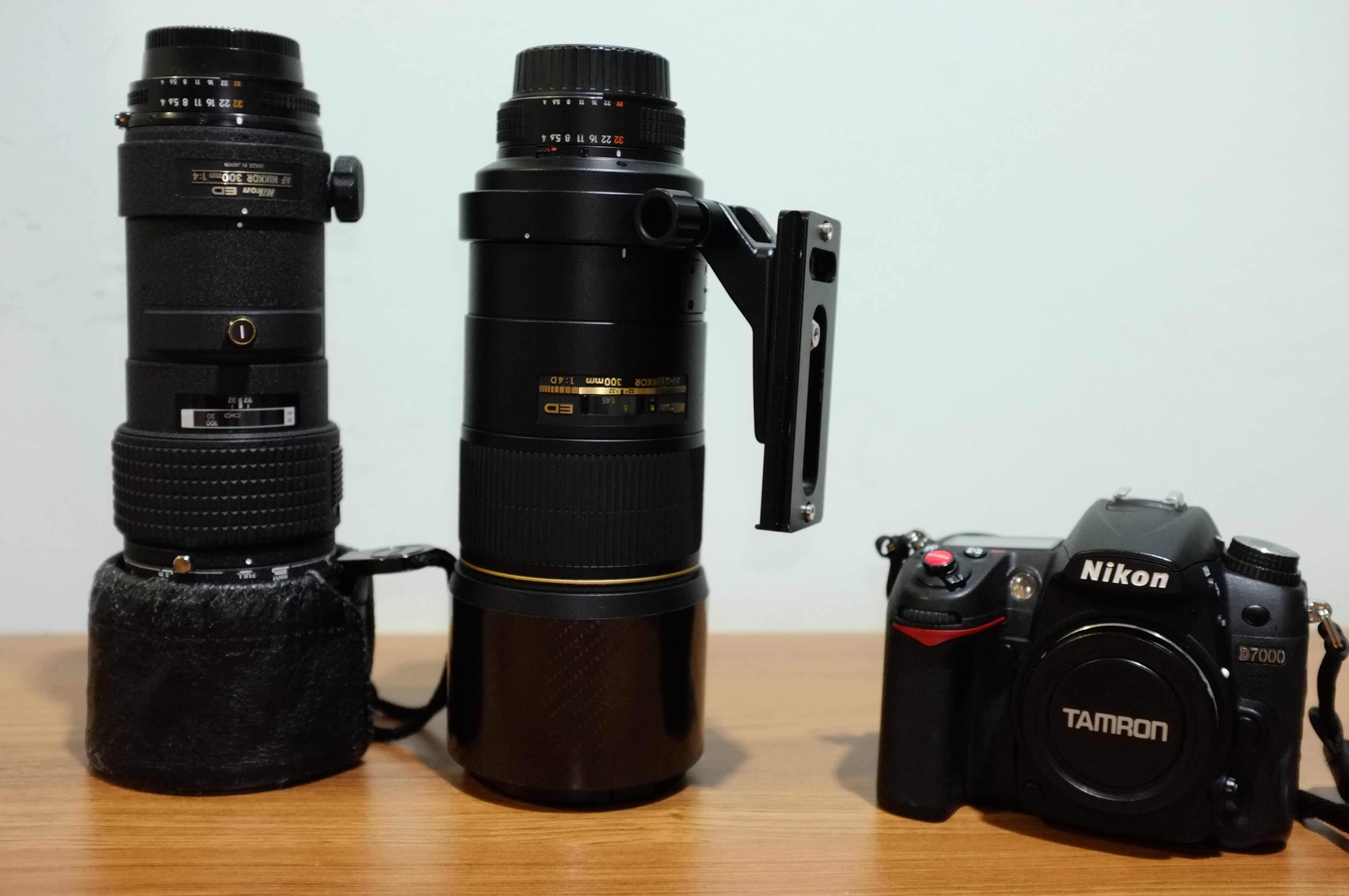
The Nikon 300mm F4 AF Gen1 and Gen2 

This is the 2nd Generation Auto-focus 300mm F4 for Nikon's line-up. This lens replaces my older AF-300mmf4 Screw-mount lens. 
In term of image quality, I cannot tell the differences. But in terms of handling, this newer lens has many advantages. 
There is a much newer 300mf4 PF verison with VR and is smaller in size which is almost twice the price of this one.
 But do note that this 2nd generation 300mmf4 AF-s lens is still in production.

This is a tack sharp lens just like the predessesor. However when it comes to focusing , this newer lens focus real fast and silently due to it's built-in motor in the lens. The retractable bulit in hood on the new lens can be "locked" compared to the 1st gen lens.

I feel this lens is lighter by a fraction compared to the older one.

The min focus of the newer lens is also closer thus i am able to focus to some wildlife which I can approach nearer. Whenever i spot a subject, static or moving, my success rate of locking it and getting pin sharp is much higher.

This lens also works well with my older Tamron 1.4x SP teleconvertor with auto focus remain smooth and well focus.

All in all this lens is an enjoyable lens and worthy upgrade from the previous generation lens. Here are some samples.


Olympus Em-1 Mark 2 , 7-14mm f2.8 & Sony RX100vi

] In recent months, I have sold the Em-1 mark1 and Lumix G95 body to revamp the equipment setup. The Lumix 12-35mm f2,8 was also sold as it ...